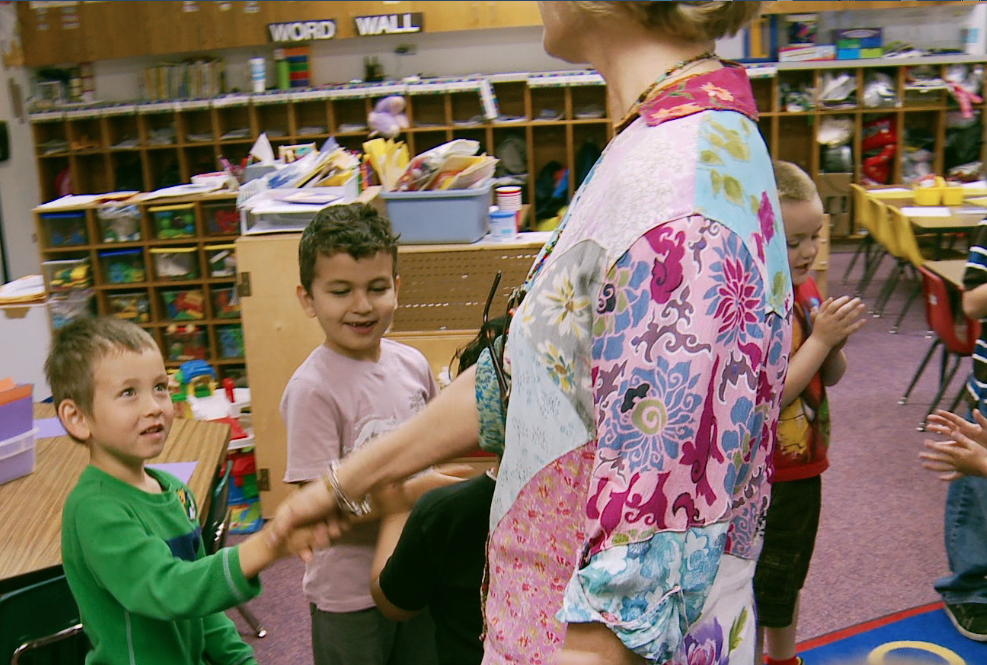
“Inside her kindergarten classroom at Will Rogers Elementary, Oklahoma teacher Miss Varnell has implemented a new and potentially controversial rule called “You Can’t Say You Can’t Play.” As academic goals go from aspirational to achieved, and behavioral problems seem to magically disappear, she is utterly surprised to find that this rule changes everything.
We meet 5-year-old Justin, whose branding as a troublemaker lands him in the principal’s office every day until he finally faces suspension. When he is moved to a new school and finds himself under the watchful eye of Miss Varnell, the experience of kindness and unconditional acceptance from his classmates is transformative.
Belonging follows Miss Varnell and her students as they work together throughout each school day to create a place where every child every student feels seen, connected and valued. We hear from teachers, parents and kindergarteners about the profound impact of this learning community on their lives.
”
RECOMMENDED READING
A sense of belonging is a basic human need, perhaps one of our most foundational. It’s not surprising that encounters with ostracism and social rejection in school can lead to loneliness, anxiety and even physical health issues for students. They may have difficulty paying attention, attempt to avoid going to school, become the frequent target of bullying, or even become a bully to others. Children who are perceived as being different in any way are at even greater risk of victimization.
At a time in America when 1 out of 3 students report having been bullied in the past 30 days, working to help all children internalize a sense of belonging might serve as a powerful antidote. In the words of former U.S. Surgeon General Vivek Murthy, “the keys to human connection are simple, but extraordinarily powerful.”
You Can’t Say You Can’t Play, by Vivian Paley. (Harvard University Press, 1993)
“Boosting School Belonging: Practical Strategies to Help Adolescents Feel Like They Belong At School”, Allen, K. and Kern, P. (UK, Routlege, 2019)
“Do Belonging Interventions for College Students Work?”, Markman, A. (Psychology Today, 2023)
Parenting: A Dynamic Perspective, Fourth Edition. Textbook by George Holden and Amanda Harrist. (Sage Publications, 2025)
Lieberman, M. D., & Eisenberger, N. I. “A pain by any other name (rejection, exclusion, ostracism) still hurts the same.” (MIT Press, 2006)
Belonging, The Science of Connection and Bridging Divides, by Geoffrey L. Cohen. (W. W. Norton & Company, 2022)